

Does Manjaro Have A Repair Disk Command
Disk partitioning is a mode of setting boundaries or creating regions to care for each storage infinite independently. Some advantages of partitioning a storage infinite include easy data recovery and backup, improve organization, ease of reinstallation, and a new hard disk. However, each partition needs to take an advisable filesystem, and information technology must be mounted at a mountain point before use.
The article demonstrates ways to partition disks in Manjaro and explains how to format and mountain disk partitions for proper drive usage.
Getting Started
The storage devices (hard disks, USBs, CD/ROM drives, and RAM disks) are known as block devices, equally they read and write data in blocks of fixed sizes. Earlier partitioning, list all the available block devices fastened to the system. Utilise the lsblk command to listing out all block devices information:
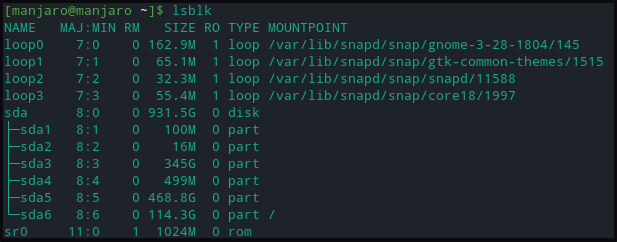
The printed output includes information on:
- Name: Device name
- RM: if the device is removable (i) or non (0)
- SIZE: device storage size
- RO: if the device is read-only
- Blazon: device type
- MOUNTPOINT: device mount point directory
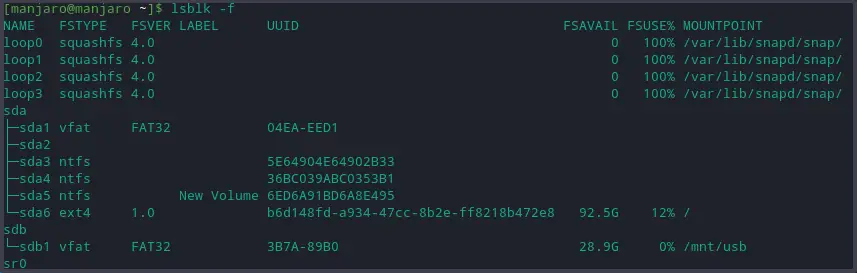
To display partitions blocks containing file organisation data:
[manjaro@manjaro ~]$ lsblk -f
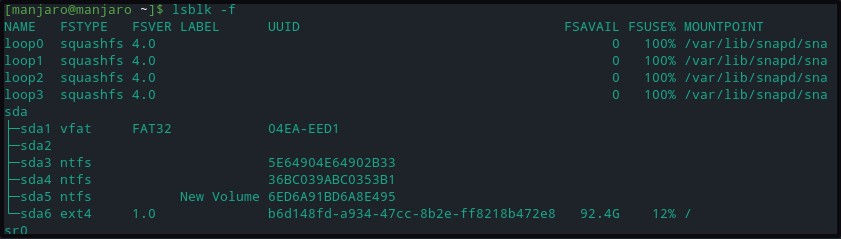
The commands above brandish each storage device with the identifiers beginning with sd and ending with letters a,b,d, etc. Such that each partition is identified by an assigned number 1,2,three, etc. The partition without any information on the filesystem is unformatted.
In case of a doubt regarding the most recently plugged storage device to be /dev/sdx. Plug the drive and use the dmesg control to view recent kernel log entries. The well-nigh recently listed drive identifier will be the one just plugged. Unplug the device and rerun the dmesg command to annotation that it isn't there.
[manjaro@manjaro ~]$ sudo dmesg | tail
[105.470055 ] sd ii:0:0:0: [sdb] Fastened SCSI removable disk
.
.
<SNIP>
Disk Division
For this tutorial, nosotros have plugged in a USB device to create partitions. Users tin create a partition on a hd via a similar method. Utilize the fdisk command to partition the storage device. The -50 flag of the fdisk command can besides listing existing partitions.
[manjaro@manjaro ~]$ sudo fdisk -l
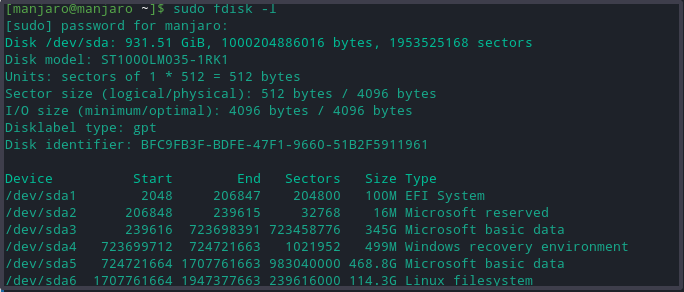

The above command prints extensive details most each bulldoze and its partitions, such every bit:
- model: storage device model
- disk: disk size and proper name
- sector size: it represents logical and physical memory size, not bachelor storage infinite.
- partition tabular array: type of sectionalisation table; gpt, aix, amiga, bsd, dvh, mac, pc98, sunday, and loop.
- disk flags: information about partition size, filesystem, type, and flags
Now choose the storage disk for creating device partitions by using the following command.
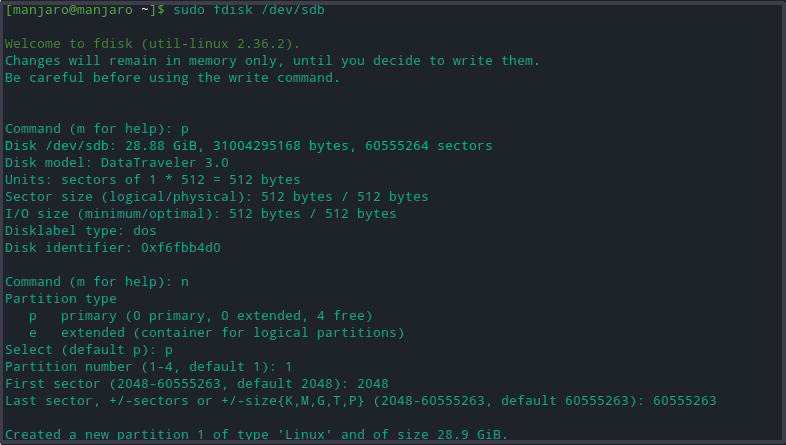
[manjaro@manjaro ~]$ sudo fdisk /dev/sdb
The in a higher place command opens the disk to write changes.
Create New Partitions
- Enter northward to make a new partition. It will prompt for the partitioning blazon, select default p primary partition.
- Type the required number of device partitions or select the default (1-4, default 1).
- It then prompts for the starting and ending hard drive sector numbers. Choose the default suggested number.
- Lastly, it prompts for inbound partition size. Users can select several sectors or tin choose the sectionalisation size in mega and gigabytes.
A message confirms the successful completion of partition formation. These changes will only remain in the memory until the user decides to write them on the deejay.
Write On Disk
Type west to write all the changes to the disk. Lastly, verify that the partitions are created by running the fdisk -l control.


Format Partitions
Without a filesystem, the drive is of no use. There are various ways to make them accessible, format partitions using the mkfs command:
- NTFS
- FAT32
- ext4
The general syntax for formatting partitions is:
[manjaro@manjaro ~]$ mkfs [options] [-t type fs-options] device [ size ]
Nonetheless, before formatting a storage drive, information technology's necessary to understand each filesystem, every bit each has its file size limitations and OS compatibility. However, all the above formats are compatible with Linux systems.
Apply the following command to format disk segmentation with ext4 format filesystem.
[manjaro@manjaro ~]$ sudo mkfs -t ext4 /dev/sdb1
To format the disk with the FAT32 file system, supercede ext4 with the vfat option in the in a higher place command:
[manjaro@manjaro ~]$ sudo mkfs -t vfat /dev/sdb1
To format with NTFS filesystem:
[manjaro@manjaro ~]$ sudo mkfs -t ntfs /dev/sdb1
Later on applying each format, verify the modify file system by locating the partition and confirming that it uses NTFS filesystem:
[manjaro@manjaro ~]$ lsblk -f
Mountain Drive Partitioning
To admission the stored data in the deejay, Manjaor Manjaro requires us to create a mount point. Mount indicate is a directory that enables user interaction with the disk partition. Information technology further ensures that Manjaro recognizes device format by reading information virtually the file organisation from the partition table.
Make a directory with the mkdir command to create a mountain signal to a preferred location.
[manjaro@manjaro ~]$ sudo mkdir -p <mountpoint>
Now mount the bulldoze partitioning to the <mountpoint>, as follows:
[manjaro@manjaro ~]$ sudo mountain -t auto /dev/sdb1 <mountpoint>
A successful mounting won't generate any output.
To verify successful mounting, use the following control.
[manjaro@manjaro ~]$ lsblk -f
Decision
The commodity details the process of storage drive segmentation cosmos in Manjaro Linux. Nosotros discussed the tools to list and view available partitions and format them in diverse file formats. The article as well demonstrated how to mountain drive partitions in Manjaro and why it's important.
About the writer

A security enthusiast who loves Terminal and Open up Source. My area of expertise is Python, Linux (Debian), Fustigate, Penetration testing, and Firewalls. I'g born and raised in Wazirabad, Pakistan and currently doing Undergraduation from National Academy of Science and Technology (NUST). On Twitter i go by @UsamaAzad14

Does Manjaro Have A Repair Disk Command,
Source: https://linuxhint.com/partition-format-hard-drive-manjaro/
Posted by: jacksonsecianced1998.blogspot.com
0 Response to "Does Manjaro Have A Repair Disk Command"
Post a Comment